Queer Places:
Naulakha, 707 Kipling Rd (historically noted as 481 Kipling Road), Dummerston, VT 05301, United States
Bateman's, Bateman's Lane, Burwash, Etchingham, East Sussex, TN19 7DS, United Kingdom
Westminster Abbey, Dean's Yard, London SW1P 3PA, United Kingdom
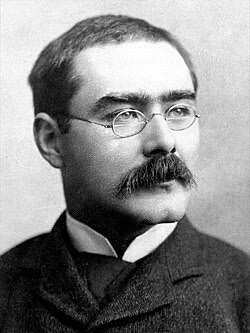 Joseph Rudyard Kipling (December 30, 1865 - January 18, 1936) was born on December 30, 1865, in Bombay, British India, to John Lockwood Kipling, an artist
and architectural sculptor, and Alice Kipling. His early years in India were culturally rich, but at the age of five he and his younger sister were sent to
England to be raised by a foster family in Southsea. This period proved profoundly traumatic due to harsh emotional and physical mistreatment by his foster
mother—an experience he later fictionalized in his short story "Baa Baa, Black Sheep". At age twelve, Kipling entered the United Services College at
Westward Ho! in Devon, a strict boarding school preparing boys for military service. Although his early years involved bullying and harsh discipline, the
environment fostered his literary ambitions, allowing him to edit the school paper and inspiring his classic school tales later collected as Stalky & Co.
(1899).
Joseph Rudyard Kipling (December 30, 1865 - January 18, 1936) was born on December 30, 1865, in Bombay, British India, to John Lockwood Kipling, an artist
and architectural sculptor, and Alice Kipling. His early years in India were culturally rich, but at the age of five he and his younger sister were sent to
England to be raised by a foster family in Southsea. This period proved profoundly traumatic due to harsh emotional and physical mistreatment by his foster
mother—an experience he later fictionalized in his short story "Baa Baa, Black Sheep". At age twelve, Kipling entered the United Services College at
Westward Ho! in Devon, a strict boarding school preparing boys for military service. Although his early years involved bullying and harsh discipline, the
environment fostered his literary ambitions, allowing him to edit the school paper and inspiring his classic school tales later collected as Stalky & Co.
(1899).
Central to his formative years at the United Services College were his close friendships with
Lionel Charles Dunsterville and
George Charles Beresford, with whom he formed an inseparable trio. Lionel Charles Dunsterville served
as the direct inspiration for the charismatic, cunning protagonist "Stalky" in Stalky & Co. Following their schooldays, Dunsterville pursued a
distinguished military career in the British and Indian armies, seeing action on the North-West Frontier and during the Boxer Rebellion, eventually rising
to Major-General and commanding the "Dunsterforce" during the First World War. George Charles Beresford served as the real-life inspiration for the
character "M'Turk". After attending the Royal Indian Engineering College and the Slade School of Fine Art, Beresford established himself as a prominent
portrait photographer in London's West End, capturing iconic portraits of literary figures including Kipling, and later writing Schooldays with Kipling
(1936).
In 1882, Kipling returned to India and settled in Lahore, working as a journalist and assistant editor for the Civil and Military Gazette. This role
exposed him broadly to the administrative machinery of British imperial India, and during his off-hours he wrote prolific amounts of verse and short
fiction, publishing his breakthrough collection of short stories, Plain Tales from the Hills (1888). Returning to England in 1889, Kipling quickly became a
literary sensation. His rhythmically driving poems of military life, such as Barrack-Room Ballads (1892), captured the public imagination and solidified
his early fame.
During his early London years in 1890, Kipling formed an intense, transformative friendship and professional collaboration with the young American
writer, editor, and literary agent Wolcott Balestier. Working together in London, the two men shared an
exceptionally close intellectual and creative bond, co-authoring the novel The Naulahka (1892) and championing each other's literary ventures. Balestier's
sudden and tragic death from typhoid fever in December 1891 at the age of twenty-eight devastated Kipling, who cut short a voyage abroad to return to his
side. Following Balestier's passing, a grieving Kipling married Balestier's sister, Caroline Balestier, in January 1892. The couple initially moved to
Brattleboro, Vermont, where Kipling experienced a rich period of literary output, writing The Jungle Book (1894), The Second Jungle Book (1895), Captains
Courageous (1897), and beginning his masterwork novel Kim (1901). Following a family legal dispute in Vermont, the Kiplings returned to England permanently
in 1896, eventually settling at Bateman's, a historic 17th-century house in East Sussex that remained Kipling's sanctuary for the rest of his life.
By the turn of the century, Kipling was widely regarded as the unofficial poet laureate of the British Empire, celebrated for works emphasizing duty,
honor, and imperial governance, alongside children's classics like the Just So Stories (1902). In 1907, he became the first English-language author to be
awarded the Nobel Prize in Literature. Despite public acclaim, his later life was shadowed by personal tragedy. During the First World War, Kipling helped
secure a military commission for his chronically short-sighted son, John. John went missing in action during the Battle of Loos in 1915 at age eighteen—a
loss that devastated Kipling and filled his later writings with agonizing grief. Kipling spent his final decades working with the Imperial War Graves
Commission, designing inscriptions for war memorials, and struggling with declining health before passing away on January 18, 1936.
Kipling lived a conventionally married life, and subscribed to traditional Victorian moral frameworks. However, modern biographers, literary critics,
and queer studies scholars have analyzed his life and writings for latent homosocial and queer dynamics. Biographer Martin Seymour-Smith argued that
Kipling's intense emotional dependency on Wolcott Balestier reflected a repressed romantic orientation, suggesting his subsequent marriage to Balestier's
sister was driven by profound grief, loyalty, and social conformity. Other literary historians noted that Kipling's deeply homosocial bonds with
contemporary figures—such as Henry James, Cecil Rhodes, and Balestier
himself—alongside his stylized, often distrustful depictions of heterosexual romance, point to an underlying psychological flight from queer impulses.
Kipling conceptualized same-sex attraction through the framework of moral ruin, warning others against it while simultaneously saturating his early
military fiction with deeply intimate, homosocial portrayals of male bonding among soldiers.
References:
Other references:
- Seymour-Smith, Martin. Rudyard Kipling: A Biography. New York: Holt, Rinehart and Winston, 1989.
- Carrington, Charles. Rudyard Kipling: His Life and Work. London: Macmillan & Co., 1955.
- Gilmour, David. The Long Recessional: The Imperial Life of Rudyard Kipling. New York: Farrar, Straus and Giroux, 2002.
- Wilson, Angus. The Strange Ride of Rudyard Kipling: His Life and Works. London: Secker & Warburg, 1977.
- Pinney, Thomas. A Kipling Chronology. Houndmills: Palgrave Macmillan, 1989.
- Beresford, George Charles. Schooldays with Kipling. London: Victor Gollancz, 1936.
- Dunsterville, Lionel Charles. Stalky's Reminiscences. London: Jonathan Cape, 1928.
- Kipling, Rudyard. Something of Myself. London: Macmillan & Co., 1937.
- Bristow, Joseph. Empire Boys: Adventures in a Man's World. London: Unwin Hyman, 1991.
- Rickets, Harry. The Unofficial Kipling. London: Weidenfeld & Nicolson, 2001.
- Sedgwick, Eve Kosofsky. Between Men: English Literature and Male Homosocial Desire. New York: Columbia University Press, 1985.
Support this project
This website is a passion project researched, developed, and funded entirely by me. If you find the content valuable and would like to help support the ongoing research and hosting costs, any contribution is deeply appreciated.
Thank you for keeping this independent resource alive!
My books on Amazon: Elisa Rolle's books
BACK TO HOME PAGE
